


November 20, 2026 · ✓ Medically reviewed by Dr. Samanth T U, ENT, Apex Multispeciality Hospital
Medically reviewed by Dr. Samanth T U, ENT and Head & Neck Surgeon (MBBS, MS (ENT), Fellowship in Head & Neck Surgery), Apex Multispeciality Hospitals, Yelahanka, Bengaluru. Review date: 20 November 2026.
This article is for general information only and is not medical advice, diagnosis or treatment. Please consult a qualified doctor about your own symptoms. See the full medical disclaimer at the end.
Introduction
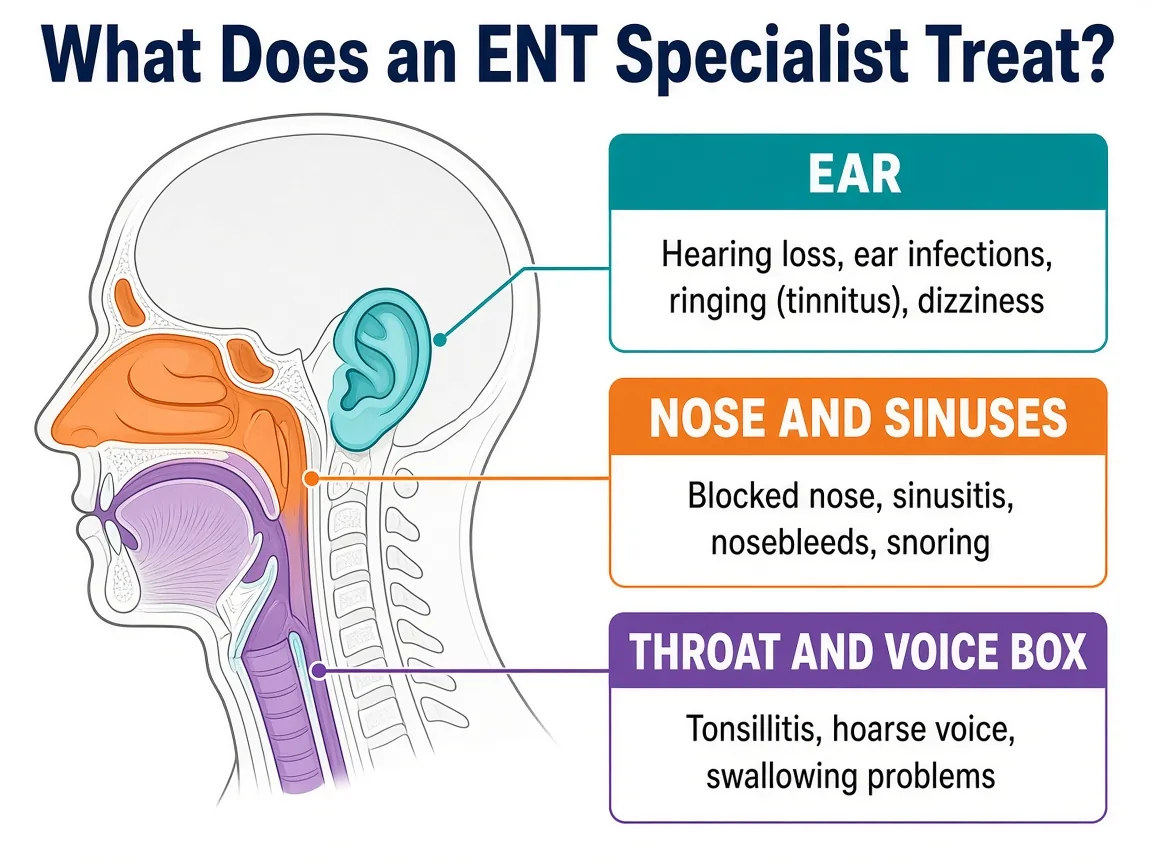
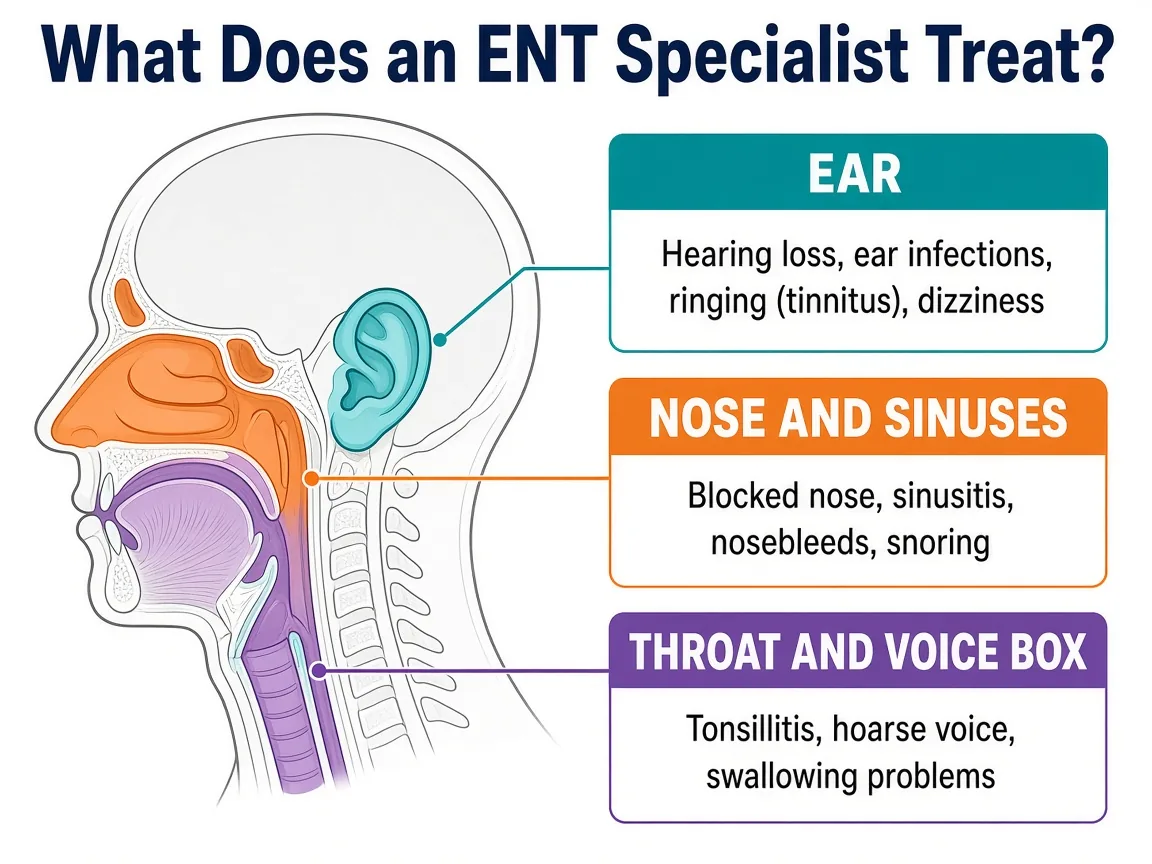
A blocked ear that will not clear, a voice that stays hoarse after a cold, a stuffy nose that keeps returning: most pass, but some need an ear, nose and throat (ENT) specialist, also called an otolaryngologist. If you live in Yelahanka or north Bengaluru, knowing when to book an ENT specialist near you can protect your hearing, breathing and voice.
These problems are common. The World Health Organization (WHO) estimates that over 5% of the world's population, about 430 million people, need rehabilitation for disabling hearing loss, and that nearly 2.5 billion people will have some hearing loss by 2050.
This guide covers seven warning signs, the red flags that need an emergency room, and what to expect from an ENT doctor in Bengaluru. It is general information, not a substitute for an examination.
Quick answer: when should you see an ENT specialist?
See an ENT specialist if you have hearing loss or ringing in the ears that persists, sinus symptoms lasting over 3 weeks or returning often, a hoarse voice for over 3 weeks, ongoing dizziness, loud snoring with breathing pauses, or a neck lump, trouble swallowing or repeated nosebleeds. Sudden hearing loss is an emergency: get seen the same day.
The 7 key warning signs
Sign 1: Hearing loss or muffled hearing
Hearing loss that does not clear up, or that comes on suddenly, needs an ENT assessment. Common signs include asking people to repeat themselves and turning the TV up louder than others need, says the NHS.
Sudden hearing loss is different. The US National Institute on Deafness and Other Communication Disorders (NIDCD) says to treat it as a medical emergency. About half of people recover some or all hearing on their own, but delay can make treatment less effective. The American Academy of Otolaryngology-Head and Neck Surgery Foundation (AAO-HNSF) reports 5 to 27 cases per 100,000 people a year, though NIDCD notes many cases go undiagnosed. Do not assume it is earwax or a blocked sinus.
Sign 2: Ringing in the ears (tinnitus) that does not go away
Tinnitus is hearing a sound with no outside source, such as ringing or buzzing. See a doctor if it is constant, regular, getting worse or affecting your sleep or mood. NIDCD says 10 to 25% of adults have tinnitus, and it is called chronic after three months. Most people with it have some hearing loss, and it is rarely linked to a serious condition.
The NHS advises an urgent appointment if the sound beats in time with your pulse, and emergency care if tinnitus comes with sudden hearing loss, facial weakness, a spinning sensation or a head injury.
Sign 3: Sinus problems that keep coming back
Sinus symptoms lasting more than 3 weeks, returning often or affecting only one side of the face are a reason to see an ENT specialist. The NHS says sinusitis usually clears within 4 weeks and suggests seeing a GP after 3 weeks of self-care. A GP may refer you to an ENT if it continues after 3 months of treatment, keeps recurring or affects one side only.
Doctors call it chronic rhinosinusitis when at least two main symptoms last 12 weeks or longer: nasal discharge, blockage, facial pain or pressure, and reduced smell. The AAO-HNSF criteria also require objective evidence of inflammation, which an ENT can check with a nasal endoscope. See also Apex's guide to sinus trouble after air-quality spikes in Hebbal and Yelahanka.
Sign 4: A sore throat, hoarseness or voice change lasting more than 3 weeks
A hoarse voice lasting more than three weeks needs a proper look at the voice box. NIDCD advises seeing a doctor if you have been hoarse for more than three weeks, especially without a recent cold or flu. Go sooner if you cough up blood, have trouble swallowing or breathing, feel a neck lump, or lose your voice completely for more than a few days.
Most hoarseness is harmless: the NHS says laryngitis usually settles in 1 to 2 weeks. If not, an ENT can examine the vocal cords with a flexible endoscope. Causes include reflux, vocal cord nodules or polyps, thyroid problems and, less often, laryngeal cancer.
Sign 5: Dizziness, vertigo or balance problems
Vertigo, a spinning feeling strong enough to affect balance, should be checked if it keeps coming back or will not go away. The NHS describes it as more than feeling dizzy, with attacks lasting seconds to hours. A doctor can do a simple balance test and refer you to a specialist if needed. Meanwhile, move your head slowly and sit down as soon as you feel dizzy.
Sign 6: Snoring, a blocked nose or signs of sleep apnoea
Loud snoring with pauses in breathing, gasping or constant daytime tiredness may be obstructive sleep apnoea (OSA) and deserves an ENT or sleep evaluation. The NHS lists the symptoms: breathing that stops and starts, gasping or choking noises, loud snoring, morning headaches and poor concentration. Ask a family member what they notice.
It is not rare in India. A 2023 meta-analysis of 11,009 Indian adults found OSA in 11% (13% of men, 5% of women), with 5% having moderate-to-severe disease. The NHS warns it can be serious if untreated, and that a CPAP machine can reduce risks such as high blood pressure.
Sign 7: A neck lump, trouble swallowing or frequent nosebleeds
A neck lump that does not go down, difficulty swallowing and repeated nosebleeds all need assessment. Swollen glands from infection usually settle in 1 to 2 weeks, says the NHS. See a doctor if they grow, feel hard or fixed, or have not gone down within a week or two, and urgently if swallowing or breathing is very difficult.
For swallowing, the NHS lists choking when eating, food feeling stuck and repeated chest infections as reasons to get help. For a nosebleed, sit forward and pinch your nose just above the nostrils for 10 to 15 minutes.
Easy-to-miss signs
Some ENT problems do not look like ear, nose or throat problems at first.
- A blocked ear on one side. The NHS says to see a nurse or doctor if earwax symptoms last beyond 5 days or you cannot hear. One-sided nose or face symptoms are also a reason for ENT referral.
- Loss of smell. The NHS lists reduced smell as a main symptom of sinusitis.
- Bad breath that will not go away. The NHS also lists it with sinusitis. If your teeth and gums are healthy, get an ENT check.
- Ear pain with no infection. Pain felt in the ear can come from the jaw joint or teeth (referred ear pain). A dental, oral and maxillofacial or ENT exam can find the source.
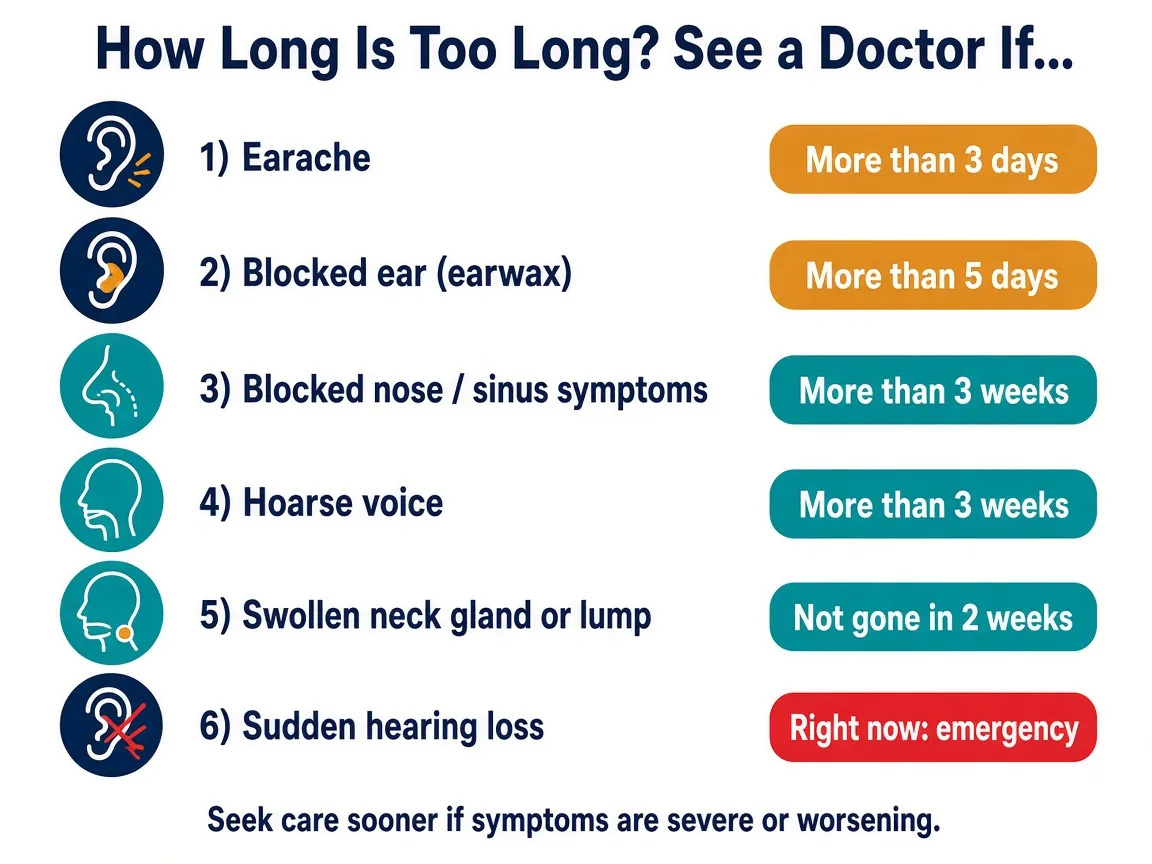
Symptom checker: what you notice and how urgent it is
Use this table as a guide, not a diagnosis. It summarises NHS, NIDCD and AAO-HNSF advice.
| Symptom | How long | Common causes | What to do |
|---|---|---|---|
| Sudden drop in hearing | Hours to 3 days | Sudden sensorineural hearing loss, often no clear cause | Emergency: same day |
| Muffled or blocked ear | More than 5 days | Earwax, fluid, infection | See a doctor |
| Earache | More than 3 days, or with discharge | Ear infection | See a doctor; urgent with fever, swelling or new hearing loss |
| Ringing or buzzing | Constant, regular or worsening | Noise, hearing loss, earwax, some medicines | ENT visit; urgent if it pulses with your heartbeat |
| Blocked nose, facial pressure | Over 3 weeks, or recurring | Sinusitis, allergy, polyps, deviated septum | ENT visit |
| Hoarse voice | Over 3 weeks | Laryngitis, reflux, nodules, rarely cancer | ENT visit soon |
| Spinning dizziness | Keeps returning | Inner ear problems | See a doctor or ENT |
| Loud snoring with breathing pauses | Ongoing | Sleep apnoea | ENT or sleep evaluation |
| Neck lump | Not gone in 1 to 2 weeks, hard or growing | Infection, thyroid problems, rarely cancer | ENT visit soon |
| Nosebleed | Over 10 to 15 minutes | Dry nose, injury, blood pressure, medicines | Emergency room |
When to go to the emergency room instead
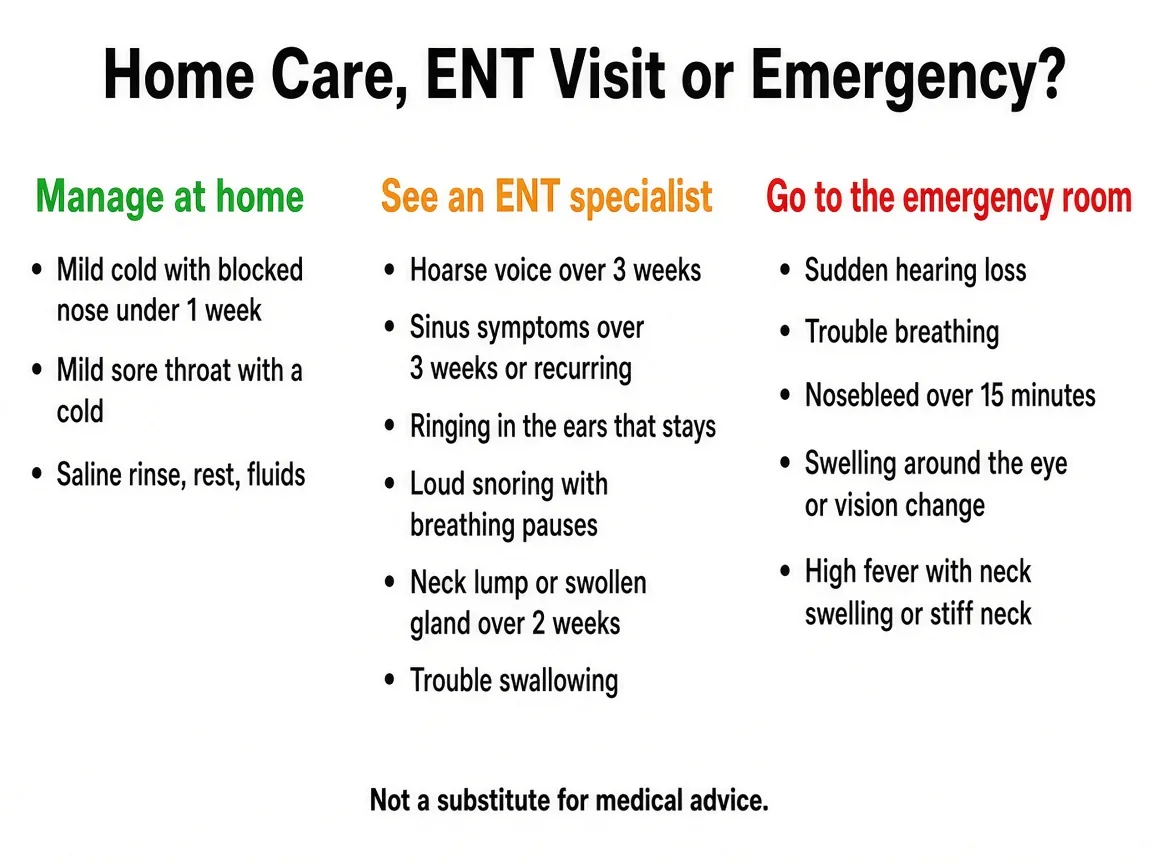
Go to the emergency room, not a routine appointment, for sudden hearing loss, trouble breathing, a nosebleed that will not stop, or severe swelling with fever.
- Sudden hearing loss. NIDCD calls it a medical emergency because early treatment improves recovery.
- Difficulty breathing. The NHS lists this as an emergency with laryngitis and nosebleeds.
- A nosebleed over 10 to 15 minutes, heavy bleeding, bleeding after a blow to the head, or with weakness or dizziness, per the NHS.
- Swelling around the eye, vision change, severe headache, stiff neck or confusion after sinus symptoms, as listed in Apex's sinus guide.
- Tinnitus after a head injury, or with facial weakness or vertigo, per the NHS.
Apex lists a 24/7 emergency hotline at 080-29917805, and its ENT department states it offers 24/7 emergency care for trauma, severe infections, nosebleeds and foreign body removal.
ENT specialist or general physician: who should you see first?
For a mild, short illness a general physician is a fair first stop. For symptoms that last, return or affect hearing, voice or one side only, go to an ENT specialist. An ENT has instruments such as an endoscope and access to hearing tests.
| Situation | Start with a general physician | See an ENT specialist |
|---|---|---|
| Cold, blocked nose or sore throat | Under 1 to 2 weeks and improving | Over 3 weeks or keeps returning |
| Hearing change | Mild, after a cold | Persistent, one-sided or gradual; same day if sudden |
| Sinus pain or pressure | First episode | Recurrent, over 3 weeks or one-sided |
| Hoarse voice | Under 2 weeks after a cold | Over 3 weeks, or with a neck lump or swallowing trouble |
| Dizziness | First check | Recurrent spinning or with hearing symptoms |
| Snoring | General advice | Loud, with pauses in breathing or daytime sleepiness |
You do not need to wait for a referral to ask for an ENT consultation. Apex's ENT page lets you request an appointment by choosing a specialty and, optionally, a doctor. If you use cashless insurance or a government scheme, ask the hospital's insurance desk about any referral rule.
Who is at higher risk?
Some people are more likely to develop ENT problems and should not delay care.
- People with diabetes. Malignant external otitis, a serious ear canal infection, most often affects people with diabetes. Severe ear pain or discharge needs prompt care. See Apex's guide to type 2 diabetes warning signs.
- Smokers and tobacco or areca nut users. WHO lists smoking as a cause of adult hearing loss, and tobacco and areca nut use are major causes of oral cancer in India.
- People exposed to loud noise at work. NIDCD notes many develop tinnitus after workplace noise.
- Adults over 60. WHO says more than 25% have disabling hearing loss.
- Teachers, singers and call-centre workers. Voice overuse is common in these jobs.
- People on medicines that affect hearing. WHO lists ototoxic medicines as a cause of hearing loss. Never stop a prescribed medicine on your own; talk to your doctor if you notice ringing.
Bengaluru-specific ENT triggers
Dust, traffic and construction pollution, plus common allergens, can aggravate the nose, sinuses and throat in Bengaluru. Fine particles and irritant gases can inflame the lining of the nose and sinuses, especially on days when air quality is poor. Apex's guide to sinus trouble after air-quality spikes in Hebbal and Yelahanka explains what to try first and when to see an ENT.
Allergy adds to this. Allergic rhinitis is common in India, and dust mites and pollen are typical triggers. An ENT specialist can help find yours, and Apex lists allergy testing among its ENT diagnostics.
For the ears, swimmer's ear is linked to water exposure and warm, humid conditions. Keep ears dry after swimming, and see a doctor if an ear is itchy, swollen, painful or draining.
ENT problems in children
Children get ear infections, enlarged tonsils or adenoids and hearing-related speech delays more often, and cannot always say what is wrong. WHO says nearly 60% of childhood hearing loss is from avoidable causes, including chronic ear infections and fluid in the ear.
- Ear infections. The NHS advises seeing a GP if earache lasts beyond 3 days, keeps returning, or the child is under 12 months. Get urgent help for fever with swelling around the ear, discharge, new hearing loss or vomiting.
- Glue ear and speech. Warning signs include speaking loudly, asking people to repeat things and turning the TV up. The NHS says glue ear lasting over 3 months may need hearing tests.
- Tonsils and adenoids. AAO-HNSF guidance says tonsillectomy is considered only after repeated, well-documented throat infections that meet strict criteria, and not every swollen tonsil needs surgery.
- Snoring. Loud snoring with breathing pauses or poor concentration needs a check, per NHS guidance. Apex states it provides paediatric ENT care for ear, nose, throat, hearing and speech concerns.
Everyday habits that harm your ears, nose and throat
Cotton buds, overused nasal sprays and loud earphones are among the most preventable causes of ENT trouble.
- Cotton buds. The NHS warns they push earwax in and make it worse. Earwax also helps protect the canal, so do not dig it out.
- Decongestant sprays. The NHS says not to use decongestant nose sprays for more than 5 days, because overuse can make a blocked nose worse (rebound congestion).
- Loud earphones. WHO says over 1 billion young adults are at risk of permanent, avoidable hearing loss from unsafe listening. Keep the volume down, use well-fitted headphones, and wear earplugs in noisy places.
- Acid reflux. NIDCD notes reflux can cause hoarseness, and some people with laryngopharyngeal reflux have no heartburn at all, only throat clearing and a hoarse voice.
Myths vs. facts about ENT problems
| Myth | Fact |
|---|---|
| "Ear wax means dirty ears." | Earwax protects the ear canal. Do not remove it with cotton buds; see a doctor if it blocks hearing. |
| "Snoring is harmless." | It can signal sleep apnoea, found in 11% of Indian adults in one meta-analysis. |
| "Sinus infections always need antibiotics." | The NHS says sinusitis is usually viral and antibiotics are rarely needed. |
| "Ringing in the ears means I'm going deaf." | Most people with tinnitus have some hearing loss, but it is rarely serious. Get a hearing test. |
| "Sudden hearing loss will come back on its own." | About half recover, but delay reduces the chance treatment works. |
| "Nasal spray is safe every day." | Decongestant sprays should not be used for more than 5 days. |
What happens if you delay treatment?
Delay can turn a treatable problem into a permanent or harder one, especially with sudden hearing loss, sleep apnoea and head and neck cancer.
- Hearing. NIDCD says treatment for sudden hearing loss delayed by more than two to four weeks is less likely to reverse permanent loss. WHO links unaddressed hearing loss to isolation, loneliness and a higher risk of dementia and cognitive decline.
- Sleep apnoea. The NHS warns it can be serious if left undiagnosed and untreated.
- Chronic sinus problems. Ongoing blockage may come from nasal polyps or a deviated septum, which need examination. Apex's ENT department lists nasal polyps and chronic sinusitis among conditions it treats.
- Head and neck cancer. India's National Cancer Registry Programme analysis of 58 hospital registries found 66.6% of head and neck cancers were diagnosed at a locally advanced stage. Most hoarseness and neck lumps turn out harmless, but one lasting weeks should be checked early.
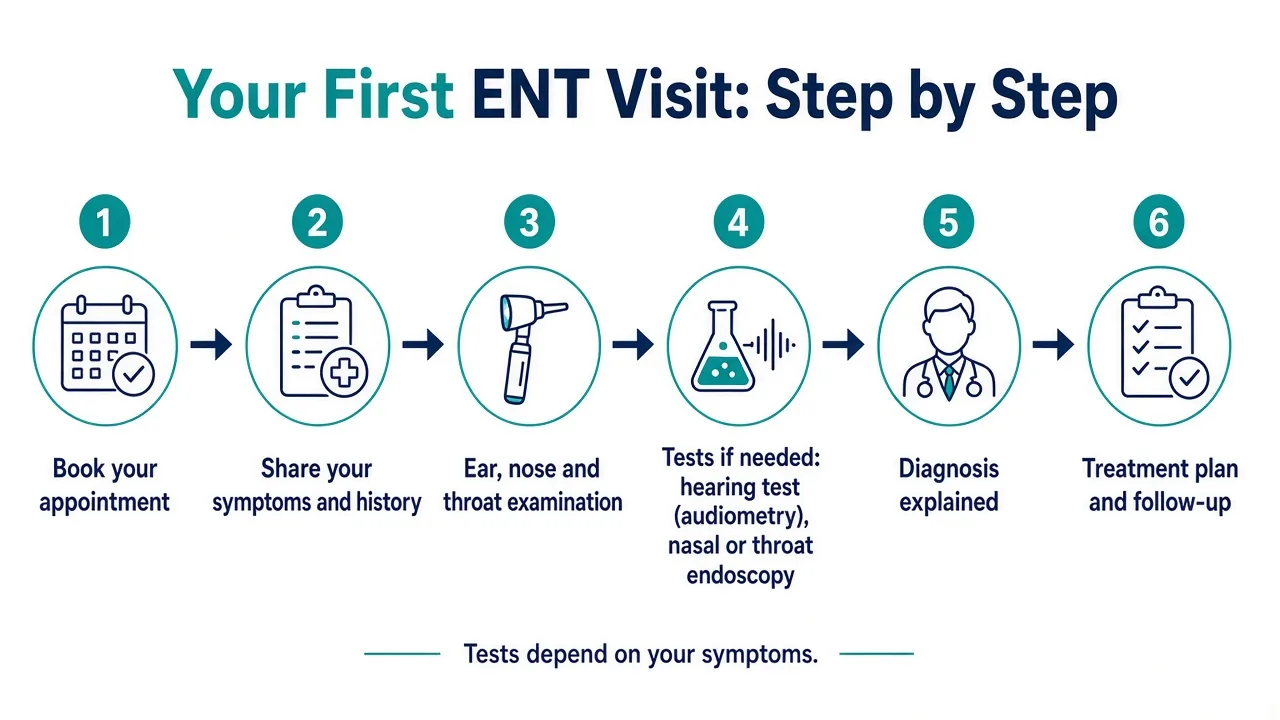
What happens at your first ENT visit
A first visit usually involves a conversation about your symptoms, an examination of your ears, nose and throat, and a few simple tests if needed.
- History. When symptoms began, which side, triggers, medicines and health conditions.
- Examination. A lighted instrument checks your ears, and your nose and throat are examined.
- Endoscopy. A thin flexible camera may show the nasal passages, throat or vocal cords. Apex lists nasal and throat endoscopy among its ENT diagnostics.
- Hearing tests. Audiometry measures how well you hear different pitches. NIDCD advises pure tone audiometry within days of sudden hearing loss. Apex lists audiometry and tympanometry (a middle ear test).
- Other tests. Depending on the problem, allergy testing or, for infants, BERA hearing testing. Apex lists both.
Treatment options at a glance
Most ENT conditions are treated first with medicines or simple care, and surgery is recommended only when it is likely to help.
- Medicines. Steroid nasal sprays and antihistamines for sinus swelling and allergy, ear drops for earwax, and steroids for sudden hearing loss.
- Hearing support. Hearing aids and, for severe loss, cochlear implants.
- Sleep apnoea care. Lifestyle changes, a CPAP machine or, in selected cases, surgery.
- Surgery. The NHS says functional endoscopic sinus surgery (FESS) is for chronic sinusitis that has not responded to treatment. Apex lists tympanoplasty, septoplasty, adenoidectomy and minimally invasive endoscopic surgery.
How to prepare for your appointment, and questions to ask
A little preparation helps your doctor reach the right diagnosis faster. Bring:
- A short symptom diary: when it began, which side, triggers and what you have tried.
- Every medicine you use, including nasal sprays, ear drops and herbal products.
- Past reports such as hearing tests, scans and discharge summaries.
- Other conditions, especially diabetes, allergies, asthma and reflux, plus your job, noise exposure and tobacco use.
- Insurance or TPA documents, if you plan to use cashless treatment.
Questions to ask your ENT doctor:
- What is the most likely cause of my symptoms?
- Do I need tests, and what will they show?
- Will this improve on its own?
- What are my options, including non-surgical ones?
- What should I avoid, such as cotton buds, sprays or loud noise?
- Which symptoms mean I should return sooner or go to the emergency room?
- When is my follow-up?
ENT care at Apex Multispeciality Hospitals, Yelahanka
Apex Multispeciality Hospitals is a 100-bedded hospital in Yelahanka, Bengaluru, with an ENT department for adults and children. It is at Bellahalli Main Road, Near Reva University, Yelahanka, Sathanur, Bengaluru, Karnataka 560064, and its ENT page says it welcomes patients from Yelahanka New Town, Jakkur and Devanahalli.
The ENT department lists hearing assessment and therapy, sinus and nasal care, throat and voice care, ENT surgery, sleep apnoea management and paediatric ENT care. Diagnostics include audiometry and tympanometry, nasal and throat endoscopy, allergy testing and BERA testing.
Meet the ENT specialist. Dr. Samanth T U holds an MBBS, MS (ENT) and a Fellowship in Head & Neck Surgery, with over 13 years of experience. His profile lists micro-ear surgeries, endoscopic sinus procedures and head and neck oncological resections. His areas of expertise include endoscopic sinus surgery and functional rhinoplasty, ear microsurgery and hearing restoration, and thyroid and head and neck surgeries. Conditions treated include chronic sinusitis, hearing loss, tonsillitis, deviated nasal septum, thyroid nodules and voice disorders.
Book an appointment:
- Appointments desk and WhatsApp: +91 82964 22571
- Hospital reception: 080-29918321
- 24/7 emergency hotline: 080-29917805
- Online: the appointment form on the ENT page, or the doctors list.
If you have any of the warning signs above, do not wait for them to settle. Book an ENT consultation in Yelahanka and get a clear answer.
FAQs
When should I see an ENT specialist?
See an ENT specialist when ear, nose or throat symptoms last over 3 weeks, keep returning, affect one side only, or involve hearing loss, a hoarse voice, ongoing dizziness, a neck lump or trouble swallowing. Sudden hearing loss needs same-day emergency care.
Where can I find an ENT specialist in Yelahanka?
Apex Multispeciality Hospitals, on Bellahalli Main Road near Reva University, has an ENT department with ENT and Head & Neck Surgeon Dr. Samanth T U. Call +91 82964 22571 or use the appointment form on the ENT page.
Do I need a referral to see an ENT doctor in Bangalore?
Not necessarily. Apex's booking form lets you request an ENT appointment directly. Some insurance plans or government schemes have their own rules, so check with the insurance desk first.
Is sudden hearing loss an emergency?
Yes. NIDCD says to treat it as a medical emergency. Early treatment works best, so get seen the same day.
Can an ENT fix snoring?
Often, yes, once the cause is found. Causes include a blocked nose, deviated septum, enlarged tonsils or adenoids and sleep apnoea. Treatment may be medicines, a CPAP machine, lifestyle changes or surgery. Apex lists sleep apnoea management among its ENT services.
Does Apex offer emergency ENT care?
Yes. Its ENT department states it offers 24/7 emergency care for trauma, severe infections, nosebleeds and foreign body removal. The emergency hotline is 080-29917805.
Key takeaways
- See an ENT specialist for hearing loss, ringing in the ears, sinus symptoms over 3 weeks, a hoarse voice over 3 weeks, ongoing dizziness, loud snoring with breathing pauses, or a neck lump, swallowing trouble or repeated nosebleeds.
- Sudden hearing loss is an emergency. Do not wait.
- Limit decongestant sprays to 5 days, and keep cotton buds out of your ears.
- In Bengaluru, pollution and allergens can aggravate the nose, sinuses and throat, especially in winter.
- Children need ENT care too, especially for repeated ear infections, loud snoring or hearing and speech concerns.
- In Yelahanka, Apex Multispeciality Hospitals offers ENT care, diagnostics and 24/7 emergency support.
Medical review
Medically reviewed by Dr. Samanth T U, ENT and Head & Neck Surgeon, MBBS, MS (ENT), Fellowship in Head & Neck Surgery, Apex Multispeciality Hospitals, Yelahanka. Review date: 20 November 2026.
Medical disclaimer
This article is for general information only. It is not medical advice, diagnosis or treatment, and it is not a substitute for seeing a qualified doctor.
- Please consult a qualified doctor about your own symptoms, tests and treatment, and do not delay or ignore medical advice because of something you read here.
- In an emergency, call your local emergency services or go to the nearest emergency room. The Apex 24/7 emergency hotline is 080-29917805.
- Reading this article, or contacting Apex through it, does not create a doctor-patient relationship.
- Every person is different, and treatment outcomes vary. Statistics and guidelines may change as new research appears.
Sources
- WHO. Deafness and hearing loss fact sheet
- NIDCD. Sudden deafness
- Chandrasekhar SS et al. Clinical Practice Guideline: Sudden Hearing Loss (Update). Otolaryngol Head Neck Surg, 2019 (AAO-HNSF)
- NHS. Sinusitis (sinus infection)
- AAO-HNSF. Diagnostic criteria for rhinosinusitis, from the Clinical Practice Guideline: Adult Sinusitis (2015)
- Systematic review and meta-analysis of the prevalence of obstructive sleep apnea in Indian adults. Sleep Med Rev, 2023
- Cancer Statistics, 2020: Report from National Cancer Registry Programme, India. JCO Glob Oncol
Other patient-information guidance referred to by name in the text comes from the NHS (pages on hearing loss, tinnitus, ear infections, glue ear, earwax, laryngitis, swollen glands, lumps, nosebleeds, swallowing problems, vertigo, sleep apnoea and decongestants) and NIDCD (tinnitus and hoarseness). Details about Apex's address, services, diagnostics and Dr. Samanth T U come from the Apex Multispeciality Hospitals website.

